I Cut Staff to Save Money. Then I Worked Out the Maths.
Executive Summary
Most operators dealing with rising wages cut staff first. It feels logical. This article is a first-hand account of why that instinct, while understandable, almost always makes the problem worse - and what the numbers actually looked like when I sat down and measured them properly.
The short version: 30 seconds saved per cover across a week of trading adds up to 286 hours of regained floor time per year and, based on my own restaurant’s figures, a conservative £21,840 in additional drink revenue.
The longer version involves a friend in Bournemouth, a ski holiday in Austria, and a question I could not stop asking myself: why does the UK think this technology is only for fast food?

Something Has Changed Out There
People are dining out less frequently. Whether that is because the tastes of younger generations have shifted, because food and drink has become genuinely too expensive, or because the media has spent the last few years telling us the economy is falling apart - I am honestly not sure. Probably all three. But I know it is true.
When people do go out now, it’s a treat. A special occasion. And they expect more for it.
I have listened to friends recently talking about nights out and family days at restaurants, coffee shops, and pubs. The common thread was consistent: the food was fine, but the service was poor. Not terrible. Just not what they had hoped for on an evening that was supposed to feel like a bit of a treat.
We all know what is happening in hospitality right now. The cost of goods is at an all-time high. Business rates are back. Labour costs do not even bear talking about. But the one thing we also know about hospitality operators - and I have been one, so I can say this - is that they are genuinely passionate about service. It is not just a job description. And no matter how good the product is, if the service does not match it, the experience falls flat.
The Trap I Kept Falling Into
When the pressure builds, the logic feels sound. Staff are often the second-biggest cost in a hospitality business, so they become the first thing you look at. I did it myself. Even on previously reliable busy nights I would cut a staff member just in case - a reaction to the week not being as busy as I had expected, an attempt to hit my labour targets.
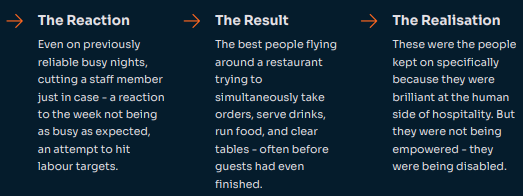
The result? My best people flying around a restaurant trying to simultaneously take orders, serve drinks, run food, and clear tables - often before the guests had even finished. These were the people I had kept on specifically because they were brilliant at the human side of hospitality. Engaging with customers. Sharing knowledge of the food and drink offer. Upselling naturally, because they genuinely cared about the guest experience.
But I was not empowering them. I was disabling them. Running them into the ground and wondering why the service felt rushed.
It made me ask an honest question: what can I actually do differently? How do I keep costs under control without breaking the people who have always delivered for me?
This is not a problem unique to my operation. According to UK Hospitality, staff turnover across the sector runs at around 75% annually — far higher than any other major industry. The pressure to cut, rotate, and run lean is universal. And the instinct to protect margin by reducing the wage bill is one almost every operator has acted on. The question is whether it actually works.
What I Kept Noticing in Europe
I started thinking about trips to France, Italy, and Spain over the years. Pretty much every bar and restaurant I had visited had waiting staff using electronic handheld devices to take orders. No pen and paper. No walking back to a fixed till to re-enter what they had written down. Just more time engaged with the table, then straight on to the next one.
So why, I wondered, do we not see this in the UK? And why had my own till provider never once suggested that handhelds might suit my business?
When I raised it with industry friends, the reaction was immediate. "They are designed for fast food outlets." "You cannot give proper service with one of those." "Your staff need eye contact with the customer, not a screen to scroll through." "It will slow everything down."
I pushed back. You are not giving eye contact when you are writing on a pad either. And if the handheld interface looks like the till your staff already know, why would it take longer? What about the time they are currently spending walking to the till and re-keying an order they have already written down?
"Good point," they all said. "But I still probably wouldn't use them."
I found that fascinating. European hospitality is not exactly known for cutting corners on service. Being a waiter in France or Italy is a serious profession, genuinely respected. If handheld technology did not improve the experience, they would not have adopted it. The fact that it is standard practice across most of the continent is itself a pretty compelling piece of evidence.
The McDonald's Effect
I think part of the problem is what I call the McDonald's effect. A few years ago you could walk into a McDonald's, order at the counter, and have your food in under a minute. It worked. People liked it.
Now you walk into what feels like a soulless unit with no human interaction, fumble through a kiosk screen, and wait for your number to be up for what seems like far longer for the exact same product. Technology was deployed there not to improve the experience but to cut labour costs, and it shows.
That model - technology as a replacement for people rather than a support for them - has left a bad taste across the whole sector. I understand why. But I think it has caused UK operators to dismiss technology that is genuinely designed to make their staff better at their jobs, not redundant.
I Decided to Try It
So I tried a handheld system myself. And after being wholly satisfied with how it worked - and, critically, getting the team on board - I started to actually measure what it was saving.

I monitored a busy weekend, with some staff using handhelds and others still using the traditional pen-and-pad approach. The process I was measuring was straightforward: walking from the table to the nearest fixed till, re-keying a handwritten order manually, then returning to the floor. That sequence repeated for every table, every course, every drinks round. Handheld ordering removes the first two steps entirely, with the order going straight to the kitchen or bar from the table.
Based on a standard table of four, I calculated the time saving at approximately two minutes per table across their stay - which works out at 30 seconds per cover. That is a conservative estimate. In practice, on nights when the till queue backs up, it is more.

What 30 Seconds Per Cover Actually Means
Here is how the numbers looked across a full week at my restaurant.
Day | Covers | Front of House Staff | Saving / server |
Weekday | 80 | 2 | 20 min |
Friday | 100 | 2 | 25 min |
Saturday | 140 | 3 | 23 min |
Sunday | 100 | 3 | 17 min |
Across a full week of trading that is approximately 5.5 hours of total reclaimed floor time. Over a year: 286 hours. Not spare capacity. Not an excuse to cut headcount. 286 hours given back to the same people, to stay on the floor, be present at tables, catch things early, and do the job they are good at.

The Bournemouth Story
When I started thinking about who I actually knew that used handhelds already, I could only come up with one person - an industry figure locally who has been running what became the busiest venue in Bournemouth for over 20 years. Always pioneering. Always leading from the front.
I called him and asked when and why he had started using handhelds. His answer stuck with me. He had first seen them working effectively in a restaurant in Austria on a skiing holiday - not in a fast-food chain, not in a corporate chain, but in a proper sit-down restaurant where the service was exceptional. He was not, at that point, a seasoned hospitality operator with years of ingrained habits. He was a businessperson driven by numbers and common sense. So he thought: that works, I should do that.
When he opened his first site - incredibly busy but in short windows, with strong seasonality - he had noticed that staff were queuing to use the fixed till. Just standing there waiting while customers sat at their tables with empty glasses. That image is what drove his handheld strategy from day one.
His insight was simple. In a lucrative but competitive seaside location, venues lost guests the moment it became difficult to get a drink. So the goal was to make sure every customer always had a drink in their hand, that they were being asked regularly if they wanted another, and that staff had a target of revisiting every table at least every five minutes. If the drinks are flowing, the service is attentive, and people are having a good time - who leaves early?
Food and drink orders went to the kitchen or bar directly from the table. The time saved went straight back into table presence. That combination turned his venue into the busiest in its area for over two decades. It is not a complicated idea. It is just executed consistently.
The Revenue Case
Going back to my own numbers, the commercial argument is straightforward once you see it.

My restaurant runs approximately 280 dinner covers per week. If reclaimed floor time means staff can offer drinks at the right moment - not rushing past, not at a till queue, but actually at the table - and a conservative 25% of dinner guests take one additional drink at an average of £6, that is 70 extra drinks per week.
70 extra drinks per week · £420 per week · £21,840 per year
Not a marketing campaign. Not a new menu. Just 30 seconds per cover given back to the people already on the floor.
I want to be clear that these are my numbers, from my restaurant, based on my monitoring. They are not a universal guarantee. The uplift will vary depending on your format, your covers, your team, and how you implement the technology. But the direction of travel is consistent: less time at the till means more time at the table, and more time at the table means more opportunities to do the things that generate revenue and satisfaction.
A Note on Honest Expectations
Handhelds are not a universal solution for every type of venue. A very small operation where the server and the till are never more than a few steps apart may find the time saving minimal. If your team is already spending almost no time on till re-entry, the efficiency gain is smaller.
What handhelds genuinely solve is the problem I was having: good people, under pressure, spending chunks of their shift on a task that could be eliminated. If that sounds like your operation, the conversation is worth having.
Why This Matters Now - And A Note On Honest Expectations
The friends who complained about poor service were not complaining about the food. They were complaining about waiting for staff who were not there - staff who were almost certainly doing something necessary but invisible to the guest. Re-keying an order. Queuing at a till. Walking back across a busy floor.
The experience suffers not because operators do not care, but because the workflow does not support the team. Technology that removes that friction is not the enemy of hospitality. It is, if you use it properly, what makes genuine hospitality possible even when you are running leaner than you would like.
At Truli, this is one of the specific operational problems we help operators think through. Handheld ordering is part of the integrated technology stack we configure and deploy - and because we install it alongside your EPOS rather than as a standalone bolt-on, the setup actually reflects how your service runs rather than forcing you to adapt to a generic template. If you want to talk through what it might look like for your venue, we are easy to reach.

Frequently Asked Questions
Will my staff resist using handheld ordering devices?
Some will, initially - and that is worth taking seriously rather than dismissing. The most effective way to handle it is to involve your most trusted team members in the trial from the start. Let them use it on a real shift and form their own opinion. In most cases, once staff have experienced a busy service without the till queue and the double-entry, resistance drops quickly. The key is not to mandate adoption before the team has had a chance to form a genuine view.
How long does it take waiting staff to get confident with a handheld EPOS?
If the handheld interface mirrors your existing till layout - which it should, if the system is configured properly - most experienced staff are comfortable within one or two shifts. The learning curve is not the device itself; it is trusting the workflow change. That confidence typically comes faster than operators expect.
Do handhelds actually slow down service or speed it up?
The concern about slowing service usually comes from imagining a handheld as a complex device that staff have to navigate while a customer waits. In practice, a well-configured handheld is faster than writing an order on a pad and then re-keying it at a till. The speed improvement is most visible on busy nights when the till queue is a bottleneck - which is exactly when you most need the time saving.
What is a realistic revenue uplift from switching to handheld ordering?
It depends on your covers, your team, and how the reclaimed time is used. Based on my own restaurant, I calculated £21,840 in additional annual drink revenue from a 25% uptake rate on one extra drink per dinner cover. Your numbers will be different. The right approach is to run your own calculation: take your weekly dinner covers, apply a conservative uptake rate, and multiply by your average drink price. Most operators who do this are surprised by how quickly the number gets significant.
Do handhelds work for all types of restaurant or just fast-casual venues?
This is the most common misconception, and the European evidence answers it clearly. Handhelds are standard in fine dining restaurants across France, Italy, and Spain - venues where service quality is the primary competitive advantage. The technology does not define the service style; the team does. A handheld in the hands of a skilled, attentive server enables better hospitality, not a more transactional one.
truli.co.uk | hello@truli.co.uk | 01580 231 880