The Two Minutes That Are Costing You a Fortune
Every walk to the till is a walk away from a sale. Here is how handhelds give back.
Saturday night. The place is full, the kitchen is flat out, three tables need drinks and one is still waiting on starters. Your best waiter is somewhere between the bar and the till, wondering whether hospitality was the right career after all. Here is the thing worth being clear about: this is not a staffing problem. You are not understaffed. It is a workflow problem, and it is costing you a fortune.
The round trip nobody counts
Watch what happens in a busy restaurant. The waiter takes the order at table six on a notepad. They walk to the fixed till at the far end of the room. They wait while a colleague finishes keying in their own order. They re-key everything by hand they’d just written down. They walk back. And they discover table nine has already given up and asked for the bill.
That round trip, table to till and back, takes about two minutes. On a standard table of four, that is thirty seconds lost per customer, every single time an order is taken. Starters. Mains. A round of drinks. Desserts. Another round. Two minutes gone each time. It doesn’t sound like much. Then you add it up across a full service.
One operator ran the experiment
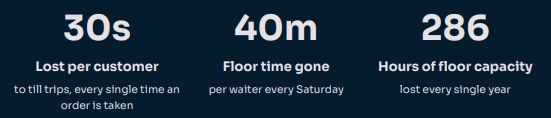
One weekend. Two waiting staff on handhelds, two on pen and pad. The result: 30 seconds lost per customer to till trips, 40 minutes of floor time gone per waiter every Saturday, and 286 hours of floor capacity lost every single year. Not an estimate from a tech company. An operator who counted it himself.
The real cost was never the two minutes. It was the round that never got offered, the dessert that nobody suggested, and the table that felt ignored and left twenty minutes early. That is where the missing profit lives.
The European standard
Think back to the last time you ate out in France, Spain, Italy or Portugal. The waiter almost certainly carried a handheld, and it almost certainly did not make the evening feel cheap. Over there, in proper restaurants and busy beach bars, handhelds have been unremarkable for well over a decade. Nobody bats an eyelid.
The UK is slower, and the reason is not what people assume. A handheld does not replace your waiter. It removes the part of the job that was never really their job, walking back and forth to a fixed point, usually behind the bar, and hands back the time to do what they are brilliant at. The best waiting staff do not dream of re-keying orders into a till. They want to be on the floor, making every table feel like the most important one in the room.
The operator who was twenty years early
One operator we know put handhelds in his first venue over twenty years ago, after seeing them in a restaurant in Austria. His peers thought he had lost the plot. His reasoning was purely practical: his place was busy and seasonal, and he could not afford to lose customers at the end of a meal simply because it was too much hassle to get another drink. So he set a rule. Every table visited every five minutes, minimum. Every glass kept full. Every next round offered before the customer had thought to look for anyone.
You cannot deliver that with a pen, a pad and a fixed till. The maths doesn’t work. With a handheld, it is achievable. Nobody leaves a great pub while the drinks are flowing, the service is warm and they are having the best night with their friends. That venue stayed the busiest in its area for two decades, not mainly for the food, good as it was, but because the service was extraordinary, and it was extraordinary because the team had the right tools and were left to get on with it.
What the numbers actually show
A 2024 Oracle Hospitality study of over 3,000 operators found venues using mobile ordering saw an average revenue uplift of 12 to 18% per customer; more drinks, more desserts, because the waiter had the time and the prompt to go back and ask. Tables turned up to 20% faster too, not from rushing anyone, but because orders hit the kitchen the instant they were taken and the rhythm of the meal tightened up on its own.
The most striking finding came from CBRE Hospitality Research in 2023; staff on handhelds reported a 31% drop in stress at peak service versus colleagues on pen and pad. Less-stressed staff read the room better, handle the tricky moments with more grace, and, the bit that touches your revenue directly, are far more likely to go back and offer that next round.
The selling tool hiding in plain sight
A well-built digital menu on a handheld is not just a way to take orders. Set up properly, it is one of the best selling tools you have ever owned. It shows your best-margin dishes first. It pairs a glass of something sparkling with the starters. It surfaces the right wine next to the main it was made for. It brings up dessert with a single tap the moment mains are cleared, before anyone has had the chance to say they are too full.
Compare that with a waiter four hours into a shift, juggling twelve tables, trying to remember whether table seven wanted the sauce on the side. The pudding offer simply does not happen. Lightspeed research in 2023 put a number on it: a 23% increase in additional items ordered with structured digital menus versus pen and pad. Not from hiring better staff or changing the menu. Just from giving the staff you already have a tool that makes it easy to do what they already want to do. The best salespeople in your venue are already on your payroll. They just need the right thing in their hands.
Truli fits handhelds that get your team off the till run and back on the floor. Ask us what that would look like in your venue. truli.co.uk | 01580 231 880