The Hidden Costs of Buying an EPOS System
Why a “free” or cheap till could cost your business thousands of pounds, and how to protect yourself before you sign.
Why can one supplier need £695 for a terminal while another can apparently provide an entire system for £299, or even nothing at all?
You have spoken to two EPOS suppliers.
The first was a conventional till company. They quoted you £695 for a dedicated commercial EPOS terminal.
They explained the specification, the warranty and why the equipment was suitable for a busy hospitality environment. They may also have quoted separately for the software, installation and support.
They did not ask to process your card payments.
The following day, you meet another provider.
They show you what appears to be a similar touchscreen till, together with a receipt printer and card machine.
This time, however, the hardware is described as free.
Or perhaps the complete package is offered for £199, £299 or £399.
Naturally, you begin to wonder whether the first till company was trying to overcharge you.
Has the second company found a way to buy EPOS equipment for a fraction of its normal cost?

No.
The touchscreen, printer, card machine and other equipment still have a real cost.
The difference is the provider’s business model.
The conventional till company normally needs to recover the cost of the equipment, together with a reasonable profit, when it sells the system to you.
The payments-led EPOS provider may be prepared to make very little profit on the hardware, sell it below its normal value or supply it for £0 upfront.
It can do this because the real opportunity is not selling you a till.
It is processing every card payment your business takes.
It may then increase the value of the relationship further by selling you additional software products.
That does not automatically make the offer bad.
A combined EPOS and payments package may offer the convenience of one commercial relationship and one provider taking responsibility when something goes wrong.
But the hardware is not free.
The provider may simply regard its cost as the price of winning a much more valuable, long-term payments customer.
That is the first thing every EPOS buyer needs to understand.
The cheapest quotation may not be the cheapest deal
When you buy an EPOS system, you are not only choosing the screen on your counter.
You may also be deciding who processes your payments, what rate is charged, which functions cost extra, who owns the equipment and how difficult it will be to move elsewhere.
This is where an apparently cheap system can become expensive.
This guide will help you see the complete relationship before you decide.
Why EPOS makes the payments customer so valuable
Changing a standalone card machine is normally manageable.
You obtain another quotation, complete an application, install the replacement machine and return the old one.
Changing an established EPOS system is very different.
Your EPOS system will contain the information your business relies on every day: your complete menu, prices, table plan, stock records, kitchen printer and display settings, online-ordering menus, accounting connections and management reports.
More importantly, it will hold the sales history your business has built up while using the system. This can show what you sold, when you sold it, which products perform best, how sales change throughout the week and how the business has developed over time.
If you operate a loyalty scheme, the system may also hold valuable information about your customers, including what they buy, how often they visit, when they normally visit and how much they spend.
Your EPOS data is a business asset
It is a detailed record of how your business operates, what it sells and who its customers are.
Your team also knows how to use the system. Your front-of-house staff understand how to enter orders, transfer tables, split bills and take payments. Your kitchen knows how orders will appear. Your managers know where to find the figures and reports they need.
Moving to another system could mean transferring valuable data, rebuilding menus, replacing hardware, reconnecting other software, retraining staff and risking disruption while the business is trading.
That makes EPOS a very sticky product.
Once your business depends on the system, you may remain with the same provider even when its payment rate is no longer competitive, simply because changing the complete platform feels too difficult.
The provider does not necessarily need to tie you into a five-year EPOS contract.
The inconvenience, cost and operational risk of moving may retain you for far longer.
Disclosure is not the same as transparency
Most providers will say their prices and conditions are published, perhaps in the terms, an order form, a separate payment agreement or a footnote beneath the headline offer.
But disclosure is not the same as transparency.
Making information technically available is not the same as helping a customer understand the commercial reality.
A headline may promote free software, £0 upfront hardware, a discounted terminal or one simple card rate.

A transparent provider should explain, in ordinary language, how it makes money from your account and what the complete relationship is likely to cost.

Hidden cost 1: the free software may not be the system you eventually need
Square provides a useful example.
Square for Restaurants Free is advertised at £0 per month, with processing charges applying whenever the business takes a card payment.
Square for Restaurants Plus currently costs £69 per month, per location.
For a new café, takeaway or small hospitality business, the free package can be an attractive and convenient way to start trading.
However, the free tier is an entry-level product rather than Square’s complete hospitality system.
The paid version includes more advanced hospitality functions, reporting, unlimited kitchen display software and 24-hour support. The free plan generally includes telephone support between 9am and 5pm, Monday to Friday.
For a business whose busiest periods are evenings and weekends, that matters.
Kiosks, loyalty, marketing and other products can increase the cost further, while hardware is purchased separately.
There is nothing wrong with charging for more advanced software.
The hidden cost appears when a free starter package is compared with another provider’s complete system without establishing what the business will actually require.
The business may load its menu, connect printers, train staff, build sales history and process payments through the platform.
When it later needs more functionality, upgrading within the same system is usually far easier than replacing it.
The honest comparison was never “free EPOS versus paid EPOS”. It was the complete cost of the system the business will actually need over the next five years.
Hidden cost 2: the advertised payment rate may not be the best rate available
Square’s standard face-to-face card rate is currently 1.75%.
A business can accept that price, register online and begin taking payments without speaking to anyone.
However, Square also says businesses processing more than £200,000 per year may be eligible for custom pricing.
That can create two customers with the same turnover who pay different rates.
The first understands that card rates may be negotiable and contacts Square.
The second trusts the advertised price and signs up online.
One may pay less simply because it knew to ask.
This matters because an independent hospitality business taking between £5,000 and £10,000 per week on cards processes approximately £260,000 to £520,000 per year.
Both figures are above Square’s published threshold for potential custom pricing.
Weekly card sales | Cost at 1.75% | Cost at 1% | Annual difference |
£5,000 | £4,550 | £2,600 | £1,950 |
£10,000 | £9,100 | £5,200 | £3,900 |
Over five years, that difference could amount to between £9,750 and £19,500.
That is before adding a paid EPOS subscription, hardware or additional software products.
Why should a customer who trusts the advertised price potentially pay more than another customer who knows to telephone and negotiate?
A well-known brand creates trust.
That trust should not prevent a business from checking whether a better rate is available.
Hidden cost 3: a simple blended rate may not be the cheapest option
It would be easy to conclude that the answer is simply to find a 1% blended rate.
That would also be too simplistic.
A blended rate applies one percentage across several common card types. It is straightforward, predictable and easy to understand.
In the quotations we review for smaller independent hospitality businesses taking between £5,000 and £10,000 per week on cards, blended rates around 1% are not unusual.
For some businesses, that can represent good value.
However, debit cards remain the UK’s most frequently used payment method. UK Finance recorded 26.1 billion debit-card payments in 2024, compared with five billion credit and charge-card payments.
A debit-heavy business may therefore be better served by separate card rates.
We regularly see consumer debit-card rates as low as approximately 0.3%.
That does not mean the business’s total cost will be 0.3%.
The complete cost may also include fixed charges per transaction, card-machine rental, authorisation charges, monthly minimums, scheme and processing fees, and higher rates for credit, commercial, international and online cards.
A low debit rate can be just as misleading as a high blended rate if the rest of the charging structure is ignored.
The lesson is not that one model is always better.
The business should be able to compare both.
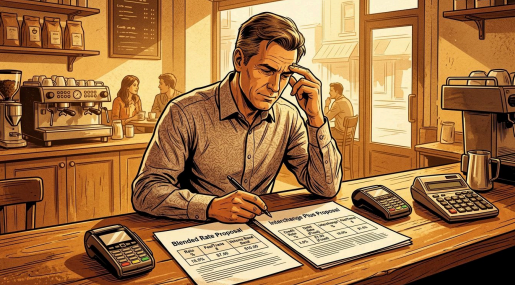
Ask providers to apply each proposal to at least three recent card-processing statements and show the complete annual cost in pounds.
The best payment deal is not the one with the most attractive headline percentage. It is the one that produces the lowest complete cost for the way your business actually takes payments.
Hidden cost 4: the hardware subsidy has to be recovered somewhere
A dedicated commercial EPOS terminal has a genuine purchase cost.
In our experience, a suitable unit will commonly sell for approximately £395 to £695, depending on its specification.
The price may reflect its processing power, screen quality, warranty, resistance to water and dust, and whether it includes staff sign-on, a printer or a customer display.
This is equipment designed for long hours in a demanding hospitality environment, rather than an ordinary consumer tablet placed on a stand.
An iPad may be entirely suitable for some businesses, but Apple does not give iPads to EPOS providers for nothing either.
A conventional EPOS company buys the equipment and sells it to the customer.
Depending on the project, it may make a gross profit margin of approximately 20 to 30%.
We are comfortable being open about that.
The margin contributes towards configuration, installation, support, warranty administration and a reasonable business profit.
A payments-led provider may treat the hardware differently.
If subsidising a £600 terminal helps it secure a customer processing hundreds of thousands of pounds in card payments each year, the subsidy can be an excellent investment.
The terminal has not become free.
It has become the cost of acquiring the payments customer.
There is also a simple ownership question to ask.
The equipment could instead be loaned, rented, financed or supplied as Hardware as a Service. You may make payments for years and still have to return it.
Ask who owns it, whether ownership will transfer, whether it must be returned and what becomes payable if you leave early.

Epos Now: a clear example of how the subsidy works
At the time of writing, Epos Now’s UK website advertises its Complete Solution from £299 plus VAT, reduced from a stated price of £849.
The package can look dramatically cheaper than the £695 quotation from the conventional till company.
However, Epos Now states that the discounted solution requires a 12-month payments, care and support subscription starting at £54 per month.
The lower hardware price is not a standalone offer.
It is connected to the software, support and payments relationship.
Epos Now’s published terms also show different propositions for customers using Epos Now Payments and those using third-party payments.
The relevant payments-linked proposition requires customers to process either at least 75% of their card transactions or a minimum of £2,000 through Epos Now Payments during each rolling 28-day period.
If the customer does not activate the service or maintain that level, Epos Now may move the customer to a differently priced proposition.
The terminal has not become cheaper to manufacture because the customer accepts Epos Now Payments.
What has changed is the expected value of the customer’s card processing.
The terms also show why ownership needs to be checked.
Depending on the proposition, ownership can pass after an applicable upfront payment, while on a no-upfront or Hardware as a Service arrangement the equipment may remain the property of Epos Now.
Epos Now is not the only provider to connect hardware incentives with payments.
It is simply a useful example because the headline price and published conditions allow the commercial model to be seen clearly.

Hidden cost 5: you may lose the freedom to choose your payment provider
A provider may tell you that its EPOS system works with other card machines.
That answer is not enough.
A payment-agnostic EPOS provider can integrate with several payment providers, allowing the sale value to pass automatically from the till to the card machine.
The real question is whether you can retain that full integration, at a fair software price, if you later choose a different payment provider.
The recent situation involving Epos Now and Dojo illustrates the risk.
Many businesses used Epos Now for EPOS and Dojo for card processing. The integration allowed the till to send the correct sale amount automatically to the Dojo card machine.
In 2026, several Dojo representatives stated publicly that the partnership had ended following Epos Now’s decision to deactivate the integration. Dojo continues to advertise more than 450 EPOS integrations.
Affected customers could move to Epos Now Payments, use Dojo without integration, accept different pricing or replace the EPOS system.
Individual terms and charges may vary, so each agreement must be checked.
The broader lesson is clear.
A merchant may believe it has chosen its EPOS and payment providers independently.
In practice, the EPOS company may still control whether the two services continue to work together.
Some providers make the restriction explicit.
Toast’s UK Merchant Agreement requires the merchant to use Toast as its exclusive provider of access to payment-processing services during the term.
Lightspeed’s 2026 UK promotional terms allow it to withdraw a free-hardware offer and charge the discounted hardware amount if the customer does not begin using Lightspeed Payments within the required period.
None of this means an integrated provider is automatically the wrong choice.
For some businesses, the convenience of one commercial relationship may be worth more than the freedom to shop around.
But the customer should make that trade consciously.
If your payment deal stops being competitive, can we move to another provider with full integration, without losing functions, paying more or replacing the EPOS system?
The five-step EPOS Freedom Test
You do not need to become an expert in EPOS contracts and card processing.
You need a clear process.
1 | Price the complete system you will actually need Do not compare the cheapest package on each provider’s website. List the tills, card machines, handheld devices, kitchen screens, kiosks, online ordering, QR ordering, pay-at-table, stock control, loyalty, reservations, integrations, reporting and support your business will require. Ask every provider to price that complete system. |
2 | Use your real card statements Provide at least three recent processing statements. Ask each provider to calculate its proposal using your actual turnover, transaction count, average transaction value and card mix. Request blended pricing and separate card rates. Where appropriate, ask for interchange-plus pricing too. Which option gives our business the lowest complete annual cost in pounds? |
3 | Follow the hardware Ask what the hardware normally sells for, what you are paying upfront, who owns it, whether it must be returned and what happens if you change payment provider or leave early. What would the same hardware and software cost if we did not take your payment-processing service? |
4 | Test your payment freedom Ask which other payment providers are supported, whether they remain fully integrated, whether using them changes the software price, whether an integration charge applies and whether the connection can be withdrawn. Ask for the answer in writing. |
5 | Compare the complete five-year cost Include software licences, hardware, payment processing, card-machine rental, additional software products, support, online-ordering charges, integration fees, installation, finance and the likely cost of moving later. The software, payments, card-machine rental and hardware finance may all have separate agreements and notice periods. UK rules limit the initial duration of qualifying card-machine lease and rental agreements to 18 months, followed by a rolling monthly arrangement. That does not mean every EPOS, software, support, payment-processing or finance agreement is limited to 18 months. The cheapest first month can become the most expensive five-year relationship. |
What the right decision looks like
The objective is not simply to find the cheapest till, the lowest headline rate or the largest bundle of free equipment.
It is to choose an arrangement with the right functions, suitable equipment, reliable support, clear ownership, transparent costs, payment choice, access to your data and a realistic route out.
Once you understand the complete arrangement, you are no longer being led by a free software offer, a discounted terminal or one attractive percentage.
You can judge the deal for yourself.
That is the position every buyer should be in.
The honest conclusion
The £695 terminal from the conventional till company may not be expensive.
It may simply be the visible price of the hardware.
The £299 or free terminal may cost less today because the provider expects to earn considerably more from the wider relationship tomorrow.
That wider cost may include card processing, paid software upgrades, additional software products, hardware conditions, higher charges for using another payment provider and the eventual difficulty of moving elsewhere.
This does not mean an integrated EPOS and payments provider is automatically the wrong choice.
It means that “free” and “cheap” are not enough information on which to make the decision.
Before you sign, ask four questions:
Why can this provider offer the hardware for hundreds of pounds less than the till company I spoke to yesterday?
Where will that cost be recovered?
Do we own the equipment?
If the payment deal stops being competitive, can we change provider without replacing the system that runs our business?
A provider offering genuine value should be able to answer those questions clearly and in writing.
Already comparing EPOS and payment proposals?
Bring us the quotations, agreements and recent card-processing statements you have received.
We will help you separate the EPOS software, hardware, additional products, processing charges, contractual commitments, ownership conditions and potential exit costs.
We will also help you compare blended and separate card rates using your actual turnover and card mix.
There is no obligation to buy from us.
If another provider’s proposal is right for your business, we will tell you.
If there are costs, restrictions or conditions you need to understand before signing, we will show you where they are.
The decision remains yours.
Our job is to make sure it is an informed one.
Fact-checking notes
Prices and provider terms were reviewed on 23 July 2026 and may change. Businesses should always review the quotation, order form and contractual documents applying to their own purchase.
1. Square currently lists Restaurants Free at £0 per month and Restaurants Plus at £69 per month per location. It publishes a 1.75 per cent card-present rate, custom pricing above £200,000 of annual processing, different support levels and separate prices for hardware and additional products. View source
2. UK Finance reported 26.1 billion debit-card payments in the UK during 2024, compared with five billion credit and charge-card payments. View source
3. Epos Now currently advertises its Complete Solution from £299 plus VAT, reduced from a stated price of £849. View source
4. Epos Now’s published terms describe the required payments, care and support subscription, the 75 per cent or £2,000 rolling 28-day processing condition, movement between propositions and its hardware-ownership arrangements. View source
5. Several Dojo representatives published the same statement attributing the end of the partnership to Epos Now’s decision to deactivate the integration. Dojo currently advertises more than 450 EPOS integrations. View source
6. Toast’s UK Merchant Agreement requires merchants to use Toast as their exclusive provider of access to payment-processing services during the agreement. View source
7. Lightspeed’s 2026 UK promotional terms allow it to revoke the free-hardware promotion and charge the discounted hardware amount where the customer does not begin using Lightspeed Payments within the stated period. View source
8. The Payment Systems Regulator limits the initial duration of qualifying card-machine lease and rental agreements to 18 months, followed by a rolling monthly arrangement. View source